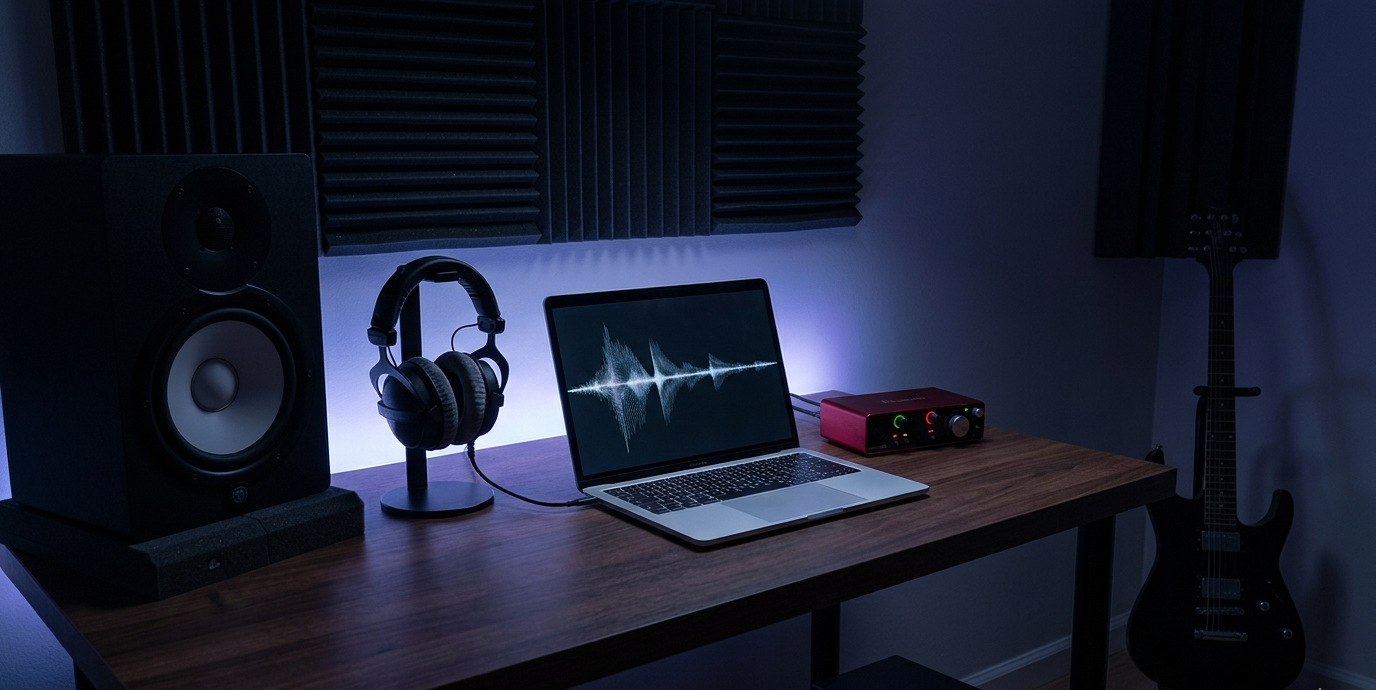
Most home studio guides are written by Americans, for Americans, with gear priced in dollars and delivered by Sweetwater. If you’re in Germany, the Netherlands, France, or anywhere else in Europe, half the advice doesn’t apply — the gear costs more, shipping takes longer, and nobody talks about the fact that your neighbour shares a wall with your studio.
This guide is different. Everything here is priced in euros, linked to European retailers (primarily Amazon), and written with the reality of flat-living in mind. Let’s build something real.
What You Actually Need (And What You Don’t)
The internet will tell you that you need a perfect acoustic room, a high-end preamp, and a microphone that costs more than your first car. Ignore that. Here’s the honest minimum to start recording music that sounds good:
- A computer (what you already have is probably fine)
- A DAW (Digital Audio Workstation) — your recording software
- An audio interface — the box that connects your mics and instruments to your computer
- Headphones OR studio monitors — to hear what you’re making
- A microphone — only if you’re recording vocals or acoustic instruments
- Basic acoustic treatment — more important than most gear upgrades
Notice what’s not on that list: hardware synthesizers, a mixing desk, a rack of outboard gear, or an acoustically designed room. You can build an excellent setup for €300–600 that will produce commercially competitive music. Let’s go through each component.
1. Your DAW: The Most Important Decision You’ll Make
Your DAW is where everything happens. Choosing one isn’t as difficult as the internet makes it seem — the differences between Ableton Live, FL Studio, and Logic Pro matter far less than how much time you spend inside one.
Here’s a quick breakdown for European producers:
- Ableton Live — Best for electronic music and live performance. The industry standard for producers who play live. Intro version is €79, Suite is €599.
- FL Studio — Best for beatmaking and hip-hop. One-time purchase model (updates are free forever) makes it exceptional long-term value at €99–199.
- Logic Pro — Mac only, but outstanding value at €229 one-time. If you’re on a Mac, this is almost certainly your best choice.
- Reaper — The honest budget pick. €60 and does virtually everything the expensive DAWs do. Ugly, but powerful.
2. Audio Interface: Your Most Important Hardware Purchase
The audio interface is the box that turns your microphone or instrument signal into something your computer can use. It also determines the quality of everything you record. A bad interface introduces noise, latency, and limitations that no amount of mixing can fix.
The good news: the best budget interfaces on the market are genuinely excellent. You do not need to spend more than €150 to get a completely professional-grade interface for home use.


3. Monitors vs Headphones: Which Should You Start With?
This is the question that generates the most debate in home studio forums, and the honest answer is: it depends on your room.
If you’re in a small, untreated flat with parallel walls and hard floors, studio monitors will actually make your mixes worse, not better — the room reflections will mislead you into making bad decisions. In this case, headphones are not a compromise; they’re the correct choice.
For apartment producers just starting out: a good pair of closed-back headphones (€80–150) will serve you far better than cheap monitors in an untreated room.


4. Acoustic Treatment: The Upgrade That Nobody Talks About
Acoustic treatment is unglamorous, difficult to photograph, and doesn’t make for good YouTube thumbnails. It is also, by a significant margin, the highest-impact upgrade you can make to a home studio.
The problem is flutter echo — the sound bouncing between parallel walls — and low-frequency buildup in corners. Both of these make your room sound bad and your mixes sound worse. The good news: you don’t need to spend thousands on professional treatment.
A practical starting point for a typical flat bedroom:
- 4–6 acoustic foam panels (30x30cm) on the wall behind your monitors and the wall behind your head
- 2 corner bass traps if budget allows
- Heavy curtains, bookshelves with books, and a sofa all help more than you’d expect


5. Putting It Together: Three Budget Tiers
Here’s what a real Studio Signal-approved setup looks like at three different budgets, all priced for European buyers:
The One Thing Most Guides Won’t Tell You
The biggest mistake new home studio producers make isn’t buying the wrong interface or the wrong microphone. It’s spending six months buying gear instead of making music.
The €400 starter setup above is capable of producing chart-quality recordings when used by someone who knows what they’re doing. Before you upgrade anything, ask yourself whether the limitation is in your room, your knowledge, or your gear — in that order. Nine times out of ten, it’s the first two.
In the next guides on Studio Signal, we’ll go deeper on every component on this list. Start with our breakdown of the best audio interfaces under €150.